|
Piano Lessons in the convenience of your home (NJ)!
(Hawthorne,
Glen Rock, Wyckoff, Ridgewood, Fair Lawn, No.Haledon,
and Bergenfield, Teaneck, Tenafly, Englewood, Englewood Cliffs, etc.

 Whatever
age or level the student is at musically -- whether beginner, intermediate
or advanced -- the lesson plan will be individually tailored to
the student's abilities, learning level and talent. When I meet
you at the initial lesson, an evaluation is made of which piano
"method" (the book[s] or series) might be most suitable
for the student's needs. Pop, classical, jazz, blues, etc. As many
international academic and scientific studies have shown, piano
study helps students in other areas of life too, and younger students
are better able to excel at schoolwork, mental ability, study habits,
and creativity. A deeper enjoyment of all kinds of music adds so
much to an appreciation of the arts and culture, and the quality
of life. Whatever
age or level the student is at musically -- whether beginner, intermediate
or advanced -- the lesson plan will be individually tailored to
the student's abilities, learning level and talent. When I meet
you at the initial lesson, an evaluation is made of which piano
"method" (the book[s] or series) might be most suitable
for the student's needs. Pop, classical, jazz, blues, etc. As many
international academic and scientific studies have shown, piano
study helps students in other areas of life too, and younger students
are better able to excel at schoolwork, mental ability, study habits,
and creativity. A deeper enjoyment of all kinds of music adds so
much to an appreciation of the arts and culture, and the quality
of life.
Intermediate and Adult Students:
Teaching
adults (and teens) has long been the most exciting musical experience
for me.
Adults want to learn on their own, and are more
than willing to put in some effort to attain goals. I structure
these lessons a bit differently, of course, than those for children.
Some older students may want to pursue a more classical music track;
some are more interested in being able to play standards and popular,
jazz and/or rock tunes. If it's good music.let's do it! The Beatles,
Beethoven, Duke Ellington, Billy Joel. it's all good. The foundations
of music itself never changes -- theory, or the mechanics of music
--is essential for an understanding of chord structure, harmony
and melodic framework. This allows you to more easily get through
a set of chords and pop tunes of any kind. The more you know about
what you're doing, the easier and more enjoyable it is to do it.
There are easy-to-undertand ways of teaching this, and I use them,
so it's not as complex as you think. Simple to more advanced classical
pieces are often introduced for technique and background for almost
all students as a basis-- but the emphasis on your own musical goals
is always a basic concern. Jazz, pop tunes, show runwa, rock, classical,
etc. Below under "METHOD BOOKS" are some examples of some
of the materials used and work we might do, if you have previously
at least a year or so of piano. It's never too late to come back
to music, no matter how long it's been!
Younger beginners:
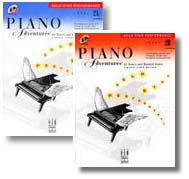 Since
every student is a unique individual, a personal approach is taken,
based on their abilities and learning capacities. Absolute beginners
are introduced to the very fundamental and easy approach of the
Alfred Method, or Faber, or perhaps Bastien. Most modern piano study
books initially use the easier learn-by-finger numbers approach
to orient the student to note values, direction of the musical "phrase"
and basic rhythms. Then, the note names on the staff are gradually
introduced. Each student's needs are evaluated in order to see if
other drills or maybe additional material is required, such as the
Alfred "NoteSpeller" books, which are highly effective
for learning the treble and bass clef notes. Other students may
have problems with counting beats and rhythms, in which case other
ways of learning and perhaps even a metronome might be recommended.
(In fact, a metronome is really a necessary -and inexpensive - tool
for anyone taking lessons. One’s approach to tempo and rhythm
is greatly improved by their use. If the student is not practicing
on an acoustic piano, some of the consumer keyboards (Casio,Yamaha,
etc. for example) have one built in. Now, most smartphones offer
various metronome apps, and almost all are FREE! Since
every student is a unique individual, a personal approach is taken,
based on their abilities and learning capacities. Absolute beginners
are introduced to the very fundamental and easy approach of the
Alfred Method, or Faber, or perhaps Bastien. Most modern piano study
books initially use the easier learn-by-finger numbers approach
to orient the student to note values, direction of the musical "phrase"
and basic rhythms. Then, the note names on the staff are gradually
introduced. Each student's needs are evaluated in order to see if
other drills or maybe additional material is required, such as the
Alfred "NoteSpeller" books, which are highly effective
for learning the treble and bass clef notes. Other students may
have problems with counting beats and rhythms, in which case other
ways of learning and perhaps even a metronome might be recommended.
(In fact, a metronome is really a necessary -and inexpensive - tool
for anyone taking lessons. One’s approach to tempo and rhythm
is greatly improved by their use. If the student is not practicing
on an acoustic piano, some of the consumer keyboards (Casio,Yamaha,
etc. for example) have one built in. Now, most smartphones offer
various metronome apps, and almost all are FREE!
In my teaching, I try to work at the individual student's
pace of learning, yet with the goal of to making progress and creating
enthusiasm-- so a modern and proven teaching approach is used, while
encouraging the student's strengths and accomplishments. Every effort
is made to make music enjoyable, and some of the early tunes are
easily recognizable by many students from nursery rhymes and songs
in school. As they grow musically, students acquire a unique discipline
that, as many studies show, has a significant effect on his or her
learning habits and later development. As a concerned music professional,
I also try to meet on an ongoing basis, as warranted, with the parent
at the lesson time if possible,to report on the student's progress
or possible challenges. Since lessons are often tightly scheduled,
this is done informally and/or as arranged, but if you ever have
questions or concerns, please feel free to call or email me). Your
child's musical progress is important to me, and I am glad to discuss
it at any time we are both available.
Method Books and Songbooks:
Various
method series books are used: I have found the Faber and/or Alfred
method series of instruction books to be very effective for most,
but , Bastien, the Brimhall series or David Carr Glover, or John
Thompson (only for the classically inclined )are also used, depending
on ability and interest.
From
time to time, I also provide various pertinent articles from the
Web about music and music theory (and theory excerpts and examples)
of specific interest as necessary. Individual classical and pop
pieces are brought in too, (Bach, Chopin, Beethoven, Schumann, Mozart,
Gershwin, Satie, Rodgers and Hart, etc.). The “tried and true”
of music never goes out of style!
Theory, Harmony and Technique
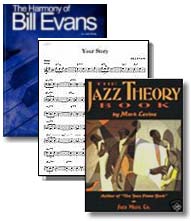 Once
again, so much of understanding music depends on learning the "mechanics
of music" so you can better read and understand sheet music,
find chords and progressions on your own and gain a capacity perhaps
to improvise and maybe even compose!. Some material I use I have
put together myself, and I also use various texts such as Mark Levine's
"Jazz Harmony", the Berklee method, Alfred’s Theory
series for beginners, Bastien's "Intermediate Theory",
and various others. For technique exercises and dexterity, the well-known
texts by Hanon and the popular "FingerPower” series are
sometimes used, as well as other source material. Some students
don't want as much theory so I go with what works best for you! Once
again, so much of understanding music depends on learning the "mechanics
of music" so you can better read and understand sheet music,
find chords and progressions on your own and gain a capacity perhaps
to improvise and maybe even compose!. Some material I use I have
put together myself, and I also use various texts such as Mark Levine's
"Jazz Harmony", the Berklee method, Alfred’s Theory
series for beginners, Bastien's "Intermediate Theory",
and various others. For technique exercises and dexterity, the well-known
texts by Hanon and the popular "FingerPower” series are
sometimes used, as well as other source material. Some students
don't want as much theory so I go with what works best for you!
JAZZ students – or those curious to study improvisation (whether
jazz or rock or pop) and accompaniment techniques : Introductory
to advanced theory and harmonic structures and analysis, voice -leading,scales
and arpeggios and progressions, a study of various types of Blues
progressions and structures, and (depending on the student's level):
various levels of pop arrangements of the Great American Songbook,
solos and standard tunes by pianist Bill Evans, various transcriptions
and arrangements, (Chick Corea, Duke Ellington, Oscar Peterson,
Bud Powell et al) charts form The Real Book(s), Andy Laverne's "Tons
of Runs", Dominic Aldis’ “Classical Approach to
Jazz Piano”and many others.
About practicing...
PRACTICE
time is really the key to the student’s progress and success.
I make a habit of advising students HOW TO practice as well –
with specific time–saving ways to work on specific parts,
making theory enjoyable and understandable, harmony methods and
interval relationships, etc. If a student does not have a dedication
to uninterrupted practice time, no matter how wonderful their abilities
may be, progress is doubtful. It needs to be productive, so the
student feels a sense of accomplishment too. Generally, younger
beginners (ages 7-10) ideally should practice for 15-20 minutes
every other day. Some beginners even prefer to practice EVERY dayfor
15 -20 minutes, and that’s great – so a regular time
should be encouraged, and parents are also asked to see that the
student does his or her best to stick to it. Of course, this needs
to be based on the student’s age, time and schoolwork concerns,
disposition, etc. Intermediate and advanced students will, of course,
need more time to do the work assigned.
After the first year or so of lessons, if all is going well, daily
practice -- or at least a concentrated 45 minutes every other day
is recommended. I give students a very reasonable amount of work
to do -- taking into account, of course, possible extracurricular
activities. Therefore, I would expect students to make every attempt
to practice the pieces assigned and to complete any additional writing
work (theory, notation, etc.) that may be given to help them progress.
There may be certain weeks where this is not possible; perhaps the
student may have mid-term or other exams, a school event, etc. This
is completely understandable. In such cases -- especially if the
student was unable to practice much that week -- it might be better
for you to call and cancel that week's lesson (with as much advance
notice as possible). This is far more preferable than for the student
to show up for the lesson unprepared, as it might be a frustrating
experience for us both.
I encourage parents to monitor the student’s practice
time often, and to support his or her musical journey. The efforts
needed to make music, and the vast enjoyment derived from being
creative through music is something from which they will gain great
benefits for a lifetime!
I appreciate your reading this material and feel free to contact
me with your questions and concerns. Thank you!
-- Mr.
Jan R. Stevens
email:music@janstevens.net
See
also my page on "BENEFITS
OF PLAYING AND STUDYING PIANO" for some scientific
facts on this subject!
Remember:
Your first lesson/evaluation is FREE,
so Email me today!

Listen here for an MP3 sample of Jan Stevens at
the keyboard...
this brief medley of three tunes runs about 3 minutes.
|
PIANO INSTRUCTION or piano/
keyboard / vocals or bands for your party!
E-mail JAN STEVENS
today and I'll get back to you right away!
( Lessons in parts of Passaic County
and Bergen County only... )
|